Reduce manual triage
Classify suitable incoming messages by type, urgency and destination.

Route incoming work with fewer manual triage steps.
Turn high-volume shared messages into classified, prioritised and traceable work items. An AI-assisted inbox can extract key fields, suggest routing and prepare replies while retaining review paths for ambiguous and urgent requests.
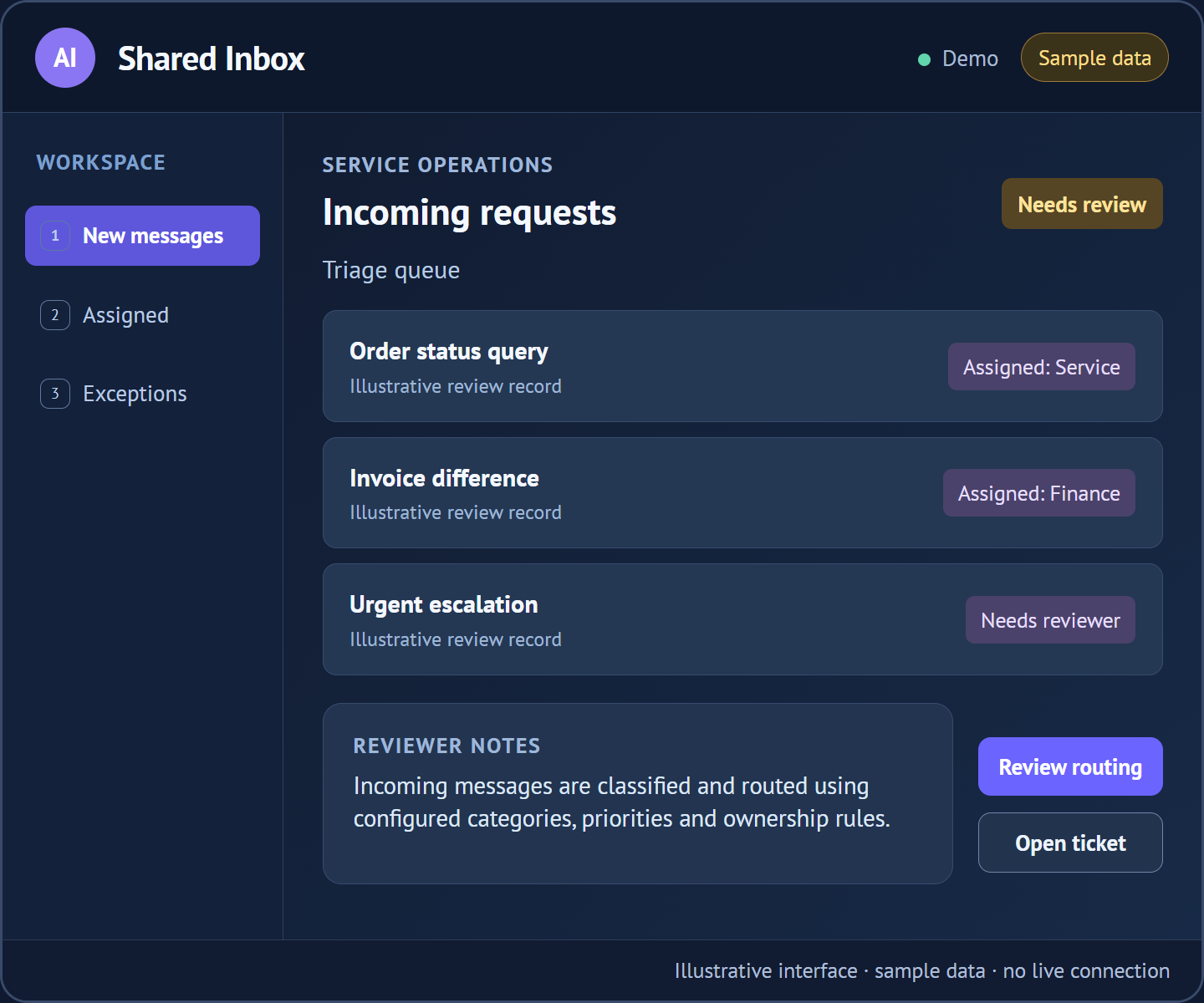
Classify suitable incoming messages by type, urgency and destination.
Highlight messages that need faster specialist attention.
Maintain traceable ownership, exception queues and SLA-related alerts.
Illustrative impact - example only
Reduce manual triage
Illustrative calculation 5,000 x 70% = 3,500
In this hypothetical month, 3,500 messages would be candidates for assisted classification. This does not mean zero errors or fully automated closure.
Illustrative scenario, not a measured client result or guarantee. Actual outcomes depend on scope, data, controls and adoption.
What we would measure
Make priorities visible
Measurement approach only - not a measured client result or guarantee. Measures and baseline are agreed with you during discovery.
What we would measure
Support more predictable handling
Measurement approach only - not a measured client result or guarantee. Measures and baseline are agreed with you during discovery.
Potential extensions, scoped separately
Read the message and extract key fields.
Assign type, urgency and destination.
Record the work item with an owner.
People handle ambiguous and urgent cases.
Protect email content and personal data under existing access controls.
Low-confidence messages fall back to people; no guarantee that nothing is missed.
Audit trail, clear ownership and routing corrections fed back into the rules.
Bring one mailbox, ticket taxonomy and routing policy. In a 30-minute discussion we look at how it could work in your environment.

Choose a 30-minute conversation or send us a short enquiry - whichever works for you.