What this solves
- SAP objects spread across many tables → error-prone joins
- KPI logic duplicated across teams and tools
- Data quality issues discovered too late (in reports)

Trusted, governed data — the prerequisite for analytics and AI. AI doesn’t fail because of models. It fails because data is inconsistent, undocumented, and not owned. We build foundations that stay reliable as your business and AI use cases evolve.
AI doesn’t fail because of models — it fails because data is inconsistent, undocumented, and not owned.
From fragmented sources → consistent entities → KPI-ready marts → AI-ready features.
We standardize source-system complexity once into reusable business entities — so every KPI and AI use case uses the same trusted logic.
Source systems hold business data in dozens or hundreds of technical tables, and KPI logic ends up duplicated across teams and tools. We collapse that complexity into a Bronze → Silver → Gold pattern: raw extracts at the bronze layer, harmonized business entities at silver, and KPI-ready data marts at gold.
The same pattern applies whenever you onboard a new source — an ERP, a CRM, a marketing platform, a custom application. Each new source plugs into the same Data Foundations layer with the same domain structure, governance, and quality controls.
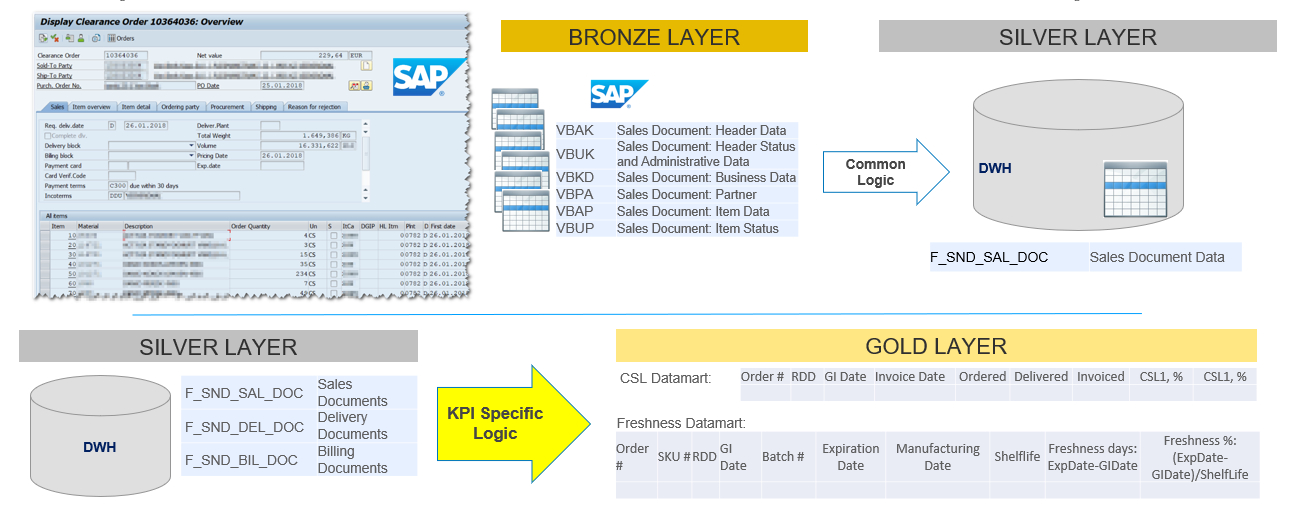
Bronze = raw extracts • Silver = harmonized entities • Gold = KPI/Datamarts
We structure the DWH by business domains, not by technical tables.
Example: SAP business entities and their core tables. The same domain approach applies to any source system.
| Business entity | Example: SAP tables |
|---|---|
| Sales Documents | VBAK, VBAP, VBEP, VBKD |
| Deliveries | LIKP, LIPS, VTTK, VTTS |
| Billing | VBRK, VBRP, BSEG |
| Materials | MARA, MARC, MARD, MBEW |
| Customers | KNA1, KNVV, KNVP |
| Vendors | LFA1, LFB1, LFM1 |
| Purchase Orders | EKKO, EKPO, EKET |
| Production Orders | AUFK, AFKO, AFPO |
A data platform is a living product — changes must be safe, testable, auditable.
Reduce cost and complexity while improving governance, scalability, and time-to-change.
Modern integration patterns and operational visibility — across cloud, hybrid, and on-prem.
Three principles guide every Data Foundations engagement: outcome-first delivery, no vendor lock-in, and business ownership built in.
See our engagement principles