Challenge
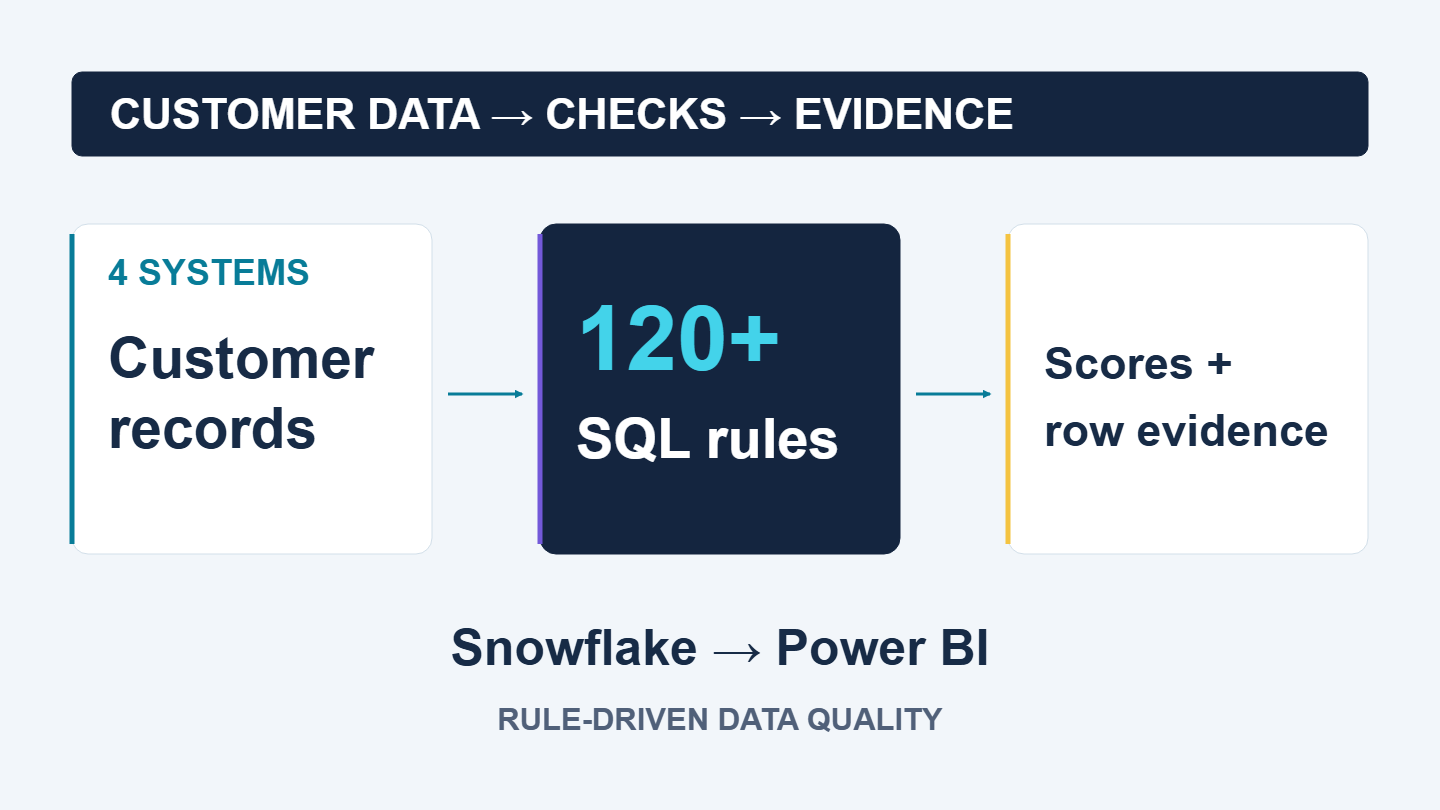
Customer data drifted across four systems, while report-based rules obscured failures and distorted scores.

A governed Snowflake framework checks customer data across four systems and gives data owners scores plus record-level evidence to act on.
Challenge
Customer data drifted across four systems, while report-based rules obscured failures and distorted scores.
Delivered solution
SQL entity views, a tested rule catalogue, a Snowflake evaluation engine and DirectQuery reporting.
Business value
Governed rules, honest scores and row-level evidence that data owners can use to correct records.
A healthcare nutrition company manages its healthcare-professional customer data across four systems: a digital identity platform, a CRM, a marketing automation platform and an e-commerce shop. Each system holds its own version of the customer, so names, emails, addresses and consents can drift apart.
The existing data quality report had grown organically. Its rules were spread across report formulas and data transformations, and its scores were calculated once per refresh, so they did not respond to filters. Some records were filtered out before they were measured, which made the scores look better than they were. The report could also say that a percentage was low, but not which records were wrong or why.
We started by reverse-engineering the existing report: every source, transformation and measure was documented, and each issue in the logic was listed. That gave a clear baseline and a list of what had to change.
We then rebuilt data quality as a framework instead of a report:
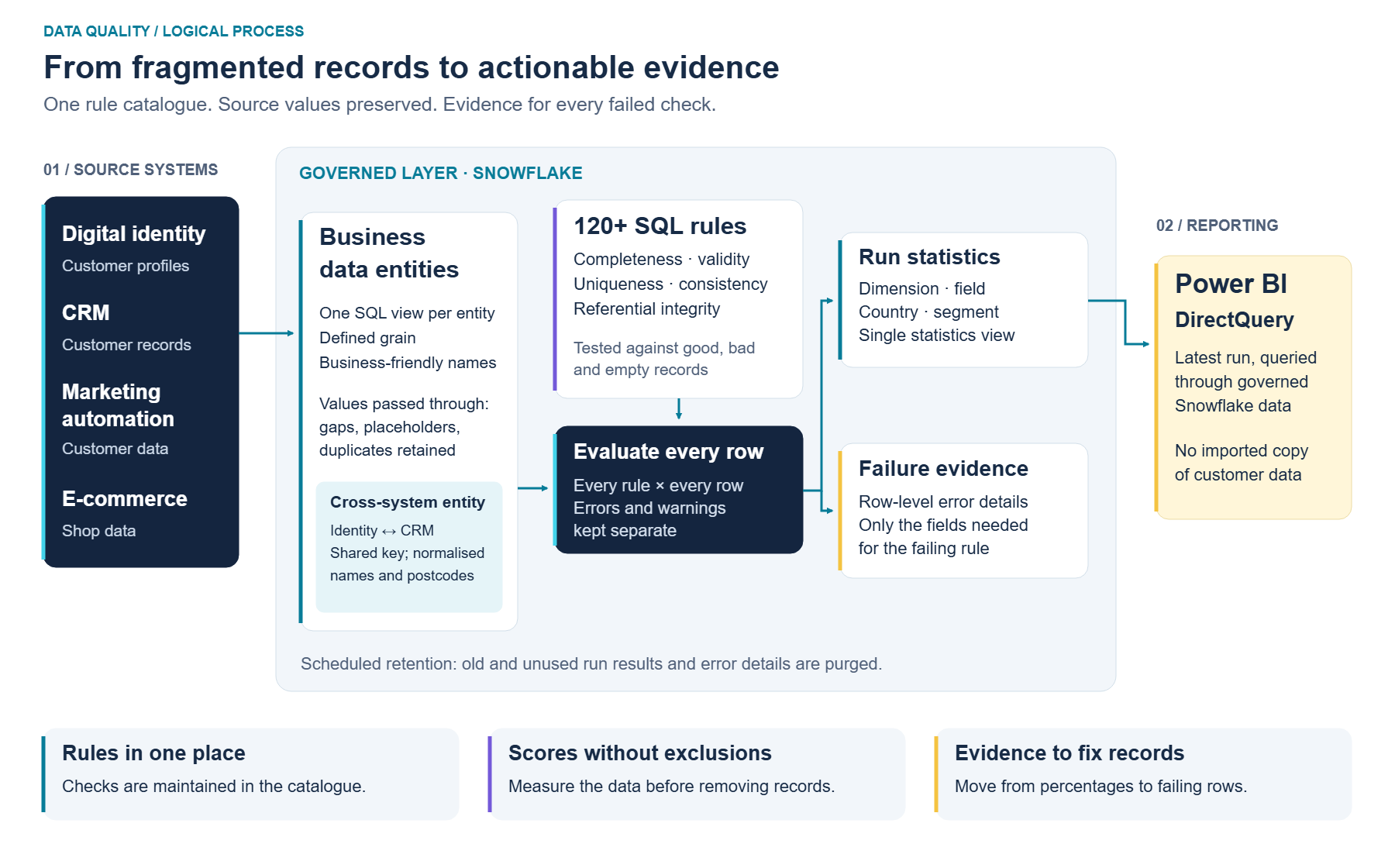
Four source systems feed business-entity SQL views in Snowflake without filtering out gaps, placeholders or duplicates. A tested catalogue of more than 120 rules drives row evaluation. The engine separates errors and warnings and produces segmented run statistics plus row-level failure evidence. A single statistics view feeds Power BI through DirectQuery. Scheduled retention purges old and unused run results and error details.
Qualitative project outcomes; no measured savings are claimed.
One governed place for data quality rules, instead of logic spread across a report
Honest scores: nothing is removed before it is measured
Row-level evidence for every failure, so data owners can fix records rather than discuss percentages
Cross-system consistency made visible: whether the same customer looks the same in the identity platform and in the CRM
Results broken down by country and customer segment, with proper totals to calculate error rates
New checks are added as a row in the catalogue; no code changes needed
No copies of customer data in the reporting tool, and no build-up of outdated results: data stays in Snowflake and is kept only as long as it is needed
Solution areas: Data Foundations · Data Governance

Choose a 30-minute conversation or send us a short enquiry - whichever works for you.